
Plumbing Problems & Solutions
Slab Leak Warning Signs Every Long Beach Homeowner Should Know
The most expensive plumbing problem a Long Beach house can hide — seven signs, one five-minute test, and the repair choices that decide whether your flooring survives.
Quick Answer
A slab leak is a failure in a water line buried beneath your concrete foundation. The classic signs are a water bill that jumps with no change in habits, the sound of running water while every fixture is off, a warm spot on the floor, damp or buckled flooring, baseboard staining, and a meter that keeps turning after the main valve is closed. Shut off the main, write down what you see, and call a licensed leak-detection plumber the same day — slab leaks never seal themselves. Long Beach plumbers recommend acting on the first sign, not the third.
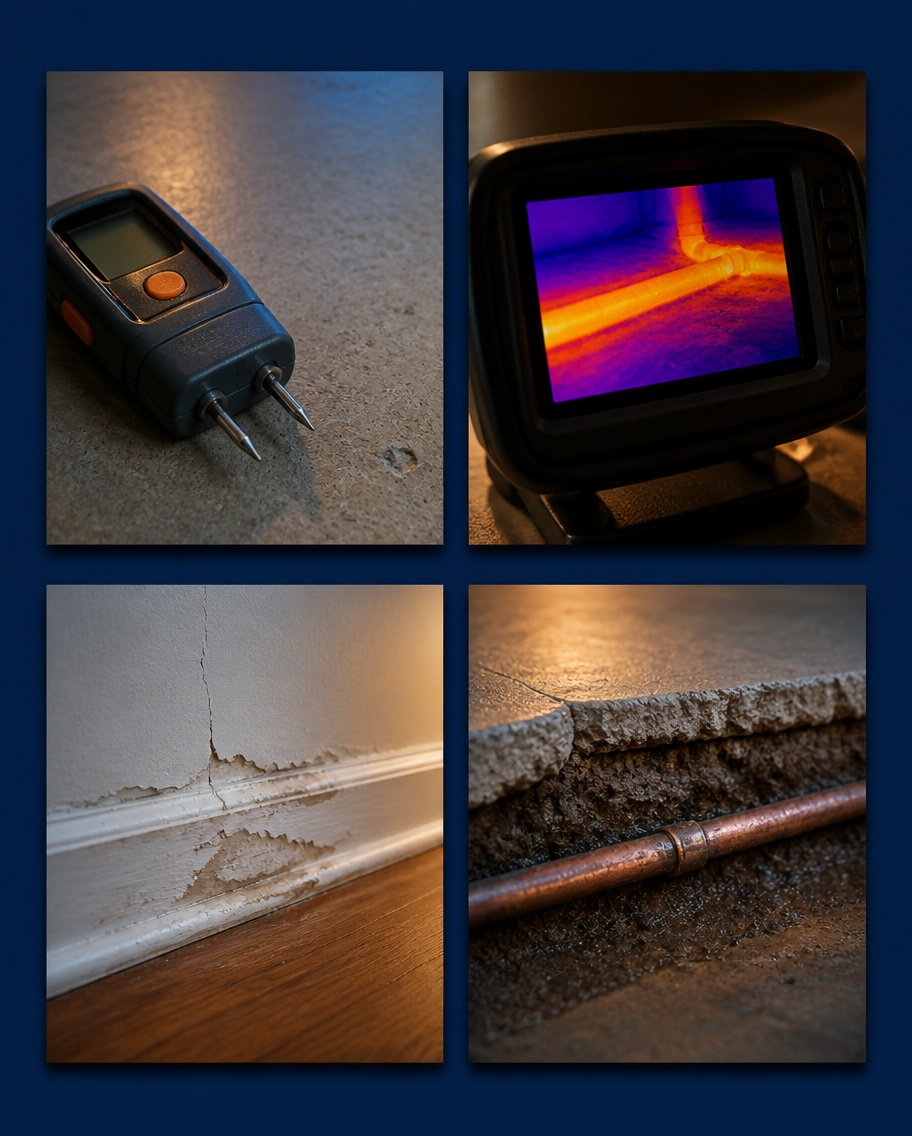
Why Long Beach homes get slab leaks
Most of Long Beach sits on post-war slab-on-grade construction, with copper water lines running beneath the foundation. Under a slab, copper meets two enemies: alkaline, chloride-rich soil and salt air corrode it from outside, while expansive clay and constant thermal cycling flex it until a pinhole opens.
A pinhole under four inches of concrete drains into the gravel bed instead of surfacing, so the first clue is usually a bill or a sound.
The seven warning signs
1. A water bill that jumps for no reason
The most reliable early signal. If habits have not changed and the bill climbs twenty percent or more across two cycles, water is leaving the system somewhere. Compare last year’s same month to rule out irrigation.
2. Running water with every fixture off
Stand in the quietest room at night and listen at the floor. A steady hiss with nothing running points to a leak under the slab. The Long Beach plumbers at A1 Best Plumbing recommend listening through a glass pressed flat to the floor — it amplifies the sound.
3. A warm spot on the floor
If the break is on a hot-water line, the concrete above it stays warm. Walk the floor barefoot in the morning before sun hits it; a patch that is consistently warm in the same place points to a hot-side leak.
4. Damp carpet, cupped boards, or a loose tile
Water wicks up through the slab and adhesive. Carpet feels cold and damp in a defined area, laminate cups at the seams, tile pops loose or sounds hollow. Any of these deserves a moisture reading before you blame humidity.
5. Staining or peeling at the baseboard
A dark tide line along the bottom of drywall, bubbling paint, or a white mineral bloom. On an interior wall with no plumbing above it, the source is usually below.
6. A musty smell that will not clear
Mustiness in one room with no visible mold usually means trapped moisture under the flooring — and a mold risk, since coastal humidity keeps the slab damp.
7. The meter keeps spinning with the main closed
The confirmatory test, and it takes five minutes. A meter that still moves with the house shutoff closed is measuring water leaving the pressurized side — the break is between meter and house, or under the slab.
Reading the signs correctly
No single sign is proof, but two together — or one that persists past a week — justify a professional survey. Detection is non-destructive: acoustic listening, thermal imaging, and tracer gas locate the break before anyone cuts concrete.
| What you notice | What it usually means | How fast to act |
|---|---|---|
| Bill up, no other symptoms | Early pinhole or running toilet | 1–2 weeks |
| Hissing under the floor | Pressurized line leaking | Same week |
| Warm patch on the slab | Hot-water line failure | Same week |
| Damp carpet or cupped boards | Water reaching the surface | Within 48 hours |
| Pooling water or foundation crack | Advanced leak, soil washout | Immediately |
The five-minute meter test
- Shut off every fixture, ice maker, and irrigation zone.
- Find the meter at the curb or in the meter box.
- Watch the low-flow indicator — the small triangle on the dial — for two full minutes.
- If it moves, close the house main shutoff and watch again.
- Stops at the house valve: leak is inside, often under the slab. Keeps moving: service line between meter and house.
How slab leaks are actually repaired
There is no single repair. The method depends on where the break sits and what is above it. The Long Beach plumbers at A1 Best Plumbing recommend choosing by location and pipe condition, not price.
- Spot repair. Open the slab above the leak, cut out the failed section, splice in new pipe. Least invasive, but it only fixes one break — on aging copper, others often follow.
- Reroute. Abandon the line and run new pipe through the attic or walls. No demolition inside the living space.
- Tunnel. Excavate from outside the footing and repair from underneath, leaving the finished floor untouched. Best near an exterior wall.
- Full repipe. The right call when the survey finds multiple failures or uniformly thin pipe. Largest investment, but it ends the cycle instead of buying time.
Key Takeaways
- A slab leak is a pressurized line failing beneath the concrete; it does not seal itself or get cheaper.
- A bill spike with unchanged habits is the earliest reliable sign.
- Two minutes on the meter’s low-flow indicator can confirm a leak before damage is visible.
- Detection is non-destructive: acoustic, thermal, and tracer-gas tools locate the break before concrete is cut.
- Spot repair, reroute, tunneling, and repipe solve different problems; location chooses the method.
Frequently asked questions
How long can a slab leak go unnoticed?
Weeks to months. Water drains into the gravel bed, so nothing surfaces until the soil is saturated — which is why a rising bill is often the only early evidence.
Can I just turn the water off and wait?
Closing the main stops the damage but leaves the leak in place — first aid, not a repair.
Will insurance cover a slab leak?
Policies commonly cover resulting water damage but exclude the failed pipe, and wording varies. Document with photos and bill history, then confirm with your adjuster.
Does a slab leak mean I need a full repipe?
Not automatically. A single isolated failure can be spot-repaired or rerouted; a repipe makes sense when detection finds multiple failures or uniformly thin pipe.
Hearing water under the floor?
A1 Best Plumbing has served Long Beach and 22 surrounding cities for more than 30 years. We locate slab leaks with acoustic and thermal detection, explain the options plainly, and confirm the price before work begins — with no overtime rates.
Call 562-268-5480 Or request service online and we will call you back.
About this guide: Written by the licensed plumbing team at A1 Best Plumbing (DBA A1 Best Plumbing & Restoration), Long Beach, CA. Licensed, bonded, and insured.