
A1 Best Plumbing · Long Beach, California · Homeowner Guide
Weak water pressure is one of the most common calls we take, and one of the most often misdiagnosed. Homeowners replace showerheads, then faucets, then the water heater — when the real cause was a half-closed valve or a failed pressure regulator. Pressure problems follow a pattern, and a five-minute test at an outdoor hose bib tells you which half of the system to investigate. Our Long Beach Plumbers recommend doing that test before buying a single part.
Quick Answer
Normal household water pressure is 40–80 psi. Test it at an outdoor hose bib with a screw-on gauge. If the bib reads normal but indoor fixtures are weak, the problem is inside your plumbing — a clogged aerator, a scaled cartridge, or a partly closed shut-off valve. If the bib reads low too, the cause is upstream: the pressure regulator, the private service line, or the city main. Sudden city-wide drops are usually utility work, not your pipes.
Table of Contents
- Test Your Pressure in 5 Minutes
- 6 Causes of Low Water Pressure
- Symptom-to-Cause Chart
- Fixes You Can Safely Do Yourself
- When to Call a Long Beach Plumber
- Frequently Asked Questions
Key Takeaways
- 40–80 psi is the target range. Above 80 psi stresses supply lines; below 40 psi starves showers, appliances and irrigation.
- One fixture or all of them? A single weak tap points to that fixture. Whole-house weakness points to the regulator, service line or city supply.
- Hot water only usually means sediment in the tank or a failing dip tube — not a pressure problem.
- A $12 gauge saves hundreds. Measure before you replace anything.
- Our Long Beach Plumbers recommend calling a pro for regulator work, leak detection, or any sudden unexplained drop.
Test Your Pressure in 5 Minutes
- Screw a hose-bib pressure gauge onto an outdoor spigot. They cost about $12 at any hardware store.
- Open the valve fully and read the dial with no other water running inside.
- Repeat with a shower running. A drop of more than 10 psi suggests a restriction between meter and house.
- Find your pressure regulator — a bell-shaped device near the main shut-off. It is the first suspect when the whole house reads low.
6 Causes of Low Water Pressure
1. Clogged aerator or cartridge (one fixture)
Mineral scale and debris collect in the aerator screen at the spout and in the cartridge behind the handle. If the screen is crusted white or gritty, that is your answer. Single-handle faucets can also lose flow when the cartridge swells.
2. Partly closed shut-off valve
Every fixture has a supply stop underneath, and every home has a main valve. One left three-quarters closed after a repair throttles the whole house. Check that all stops are turned fully counter-clockwise and open.
3. Failing pressure regulator
Most Long Beach homes have a regulator bringing street pressure down to a safe level. Regulators fail in both directions: shut, and pressure falls house-wide; open, and it can spike past 100 psi and start blowing supply lines.
4. Corroded galvanised or scaled copper pipe
Old galvanised steel rusts from the inside until the bore is a fraction of its original size. The tell is progressive loss over years, worst at the farthest fixtures, often with slightly discoloured water on first draw.
5. Sediment in the water heater (hot side only)
If cold pressure is fine and hot is weak, the tank is the suspect. Sediment layers the bottom, and a failing dip tube can dump cold water at the top. Neither is fixed by touching the showerhead.
6. Hidden leak or city-side issue
A slab leak or failing service line bleeds pressure before it reaches your fixtures.
Symptom-to-Cause Chart
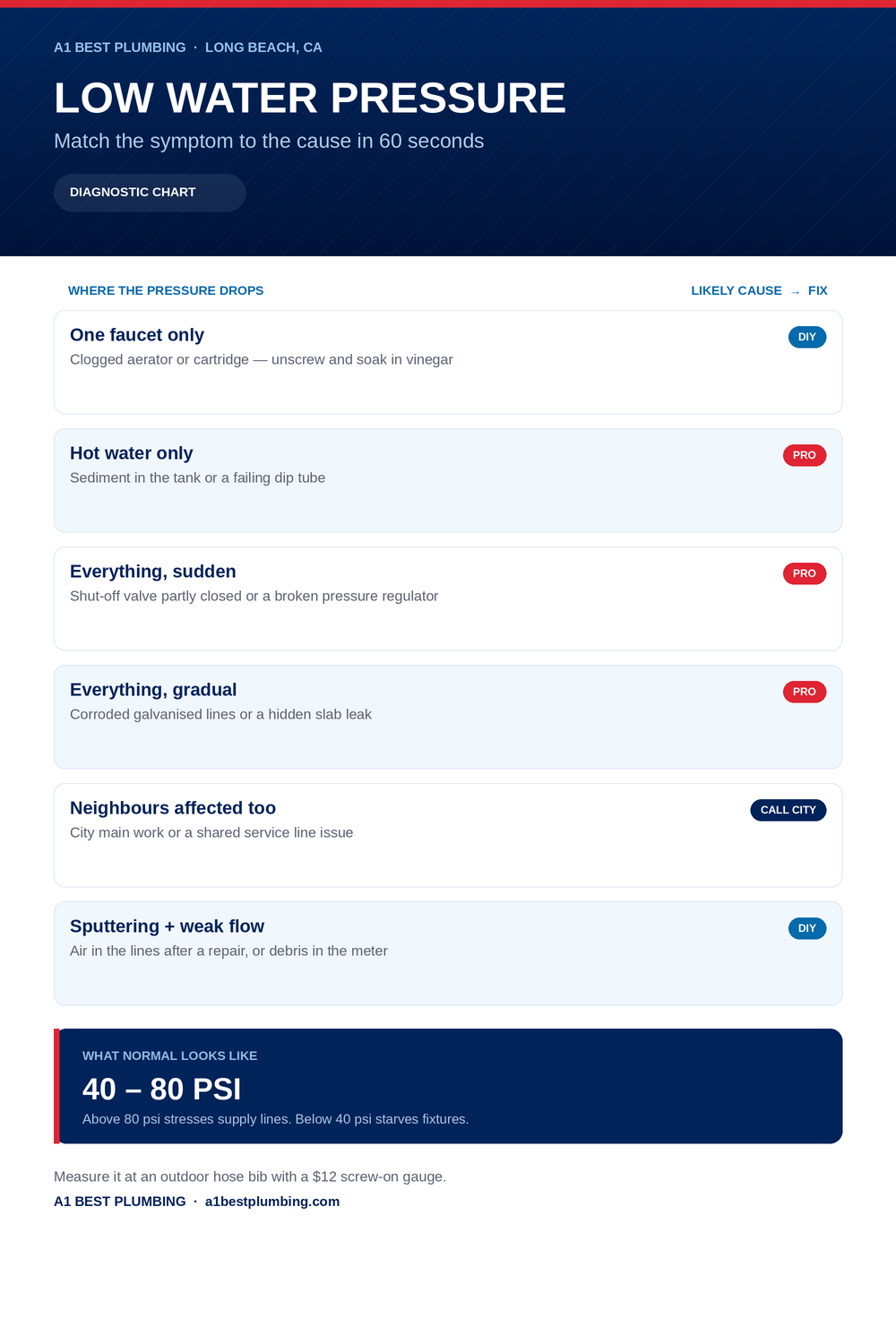
| Where pressure drops | Most likely cause | Who should fix it |
|---|---|---|
| One faucet only | Clogged aerator or cartridge | DIY |
| Hot water only | Sediment or dip tube failure | Licensed plumber |
| Whole house, sudden | Shut-off valve or failed regulator | Licensed plumber |
| Whole house, gradual | Corroded pipe or hidden leak | Licensed plumber |
| Neighbours affected too | City main or shared service line | Water utility |
| Sputtering, then weak flow | Air in the lines or debris in the meter | DIY, then plumber |
Fixes You Can Safely Do Yourself
- Clean the aerators. Unscrew, soak in white vinegar two hours, rinse, refit. Do every faucet at once so you can compare results.
- Open every supply stop fully. Under sinks, behind toilets, at the washer box, and at the main valve.
- Replace a showerhead cartridge or head.
- Flush the water heater if hot-side flow has faded. Run a hose from the drain valve to a safe drain until the water runs clear.
- Check for a running toilet or irrigation leak quietly stealing flow. Shut the house valve and watch the meter; movement means a leak.
What not to do: adjust the regulator yourself, open a wall to chase a slab leak, or force the main valve past its stop.
When to Call a Long Beach Plumber
- The hose-bib gauge reads below 40 psi or above 80 psi.
- Pressure dropped suddenly house-wide with no obvious cause.
- You hear water running with everything off, or see damp patches on floors or baseboards.
- The pressure regulator is over 10–15 years old and has never been tested.
- Your home still has galvanised supply lines and pressure has declined for years.
Our Long Beach Plumbers recommend diagnosing before replacing. A regulator swap is a straightforward repair; a repipe is a major investment, and the two look identical to a homeowner with a weak shower. A gauge reading and a visual inspection separate them in under an hour.
Frequently Asked Questions
What is considered normal water pressure in a house?
40 to 80 psi. Most fixtures are rated to a maximum of 80 psi, and appliances perform best at 50–70 psi. Above 80 psi, hoses and valve seals wear out prematurely; below 40 psi, showers and irrigation underperform.
Does low water pressure mean I have a leak?
Not necessarily. A leak lowers pressure only if it bleeds enough volume. The reliable test is the meter: shut every fixture off and watch whether the dial still moves.
Can I just turn up my pressure regulator?
You can, but it won’t fix a failed regulator or a restricted pipe. Adjusting a worn unit often gives a temporary rise, then a spike that damages fixtures.
Why is only my hot water pressure low?
Sediment in the tank, a failing dip tube, or scale in the hot-side cartridge. Because hot water passes through the heater and a longer run of pipe, it collects more mineral deposits. Flushing the tank resolves most cases.
Get Your Pressure Back Without Guessing
Pressure problems are diagnosable. A gauge reading, a look at the regulator and a check of the main valve answer most of the question in one visit — which is exactly how A1 Best Plumbing approaches it. We serve Long Beach, Lakewood, Signal Hill and Seal Beach with licensed, insured plumbers.
Weak flow at every tap? Schedule a pressure diagnosis and we’ll measure the system, test the regulator, and give you a straight answer. Request service online or call A1 Best Plumbing today.