
Quick Answer
Yes — California law requires water heaters to be braced, anchored, or strapped to resist earthquake movement. California Plumbing Code Section 507.2 and California Health & Safety Code Section 19211 require this for new, replacement, AND existing residential water heaters. The standard is at least two strap sets: one in the upper third and one in the lower third of the tank.
If you live in Long Beach, the Newport-Inglewood fault runs directly through your city — which is why California treats water heater strapping as the law, not a suggestion. In this guide, our Long Beach Plumbing Company recommends knowing what the code requires, how to check your heater in under five minutes, and what to do if it isn’t compliant.
Table of Contents
- What California Law Requires
- Why Strapping Is Mandatory, Not Optional
- Strapping Requirements Explained
- How to Check Your Water Heater in 5 Minutes
- Do Tankless Water Heaters Need Strapping?
- What Compliance Costs
- Frequently Asked Questions
Key Takeaways
- Strapping is required statewide under California Plumbing Code §507.2 and Health & Safety Code §19211 — for new, replacement, and existing tanks alike.
- Two straps minimum: one in the upper third, one in the lower third of the tank.
- Straps must anchor to structural framing — not just drywall — and flexible gas connectors let the unit move without breaking lines.
- An unstrapped 40-gallon tank holds roughly 300+ pounds of water; in an earthquake it can tip, snap the gas line, and ignite a fire or flood your home.
- Our Long Beach Plumbing Company recommends having straps professionally installed or verified — incorrect DIY strapping fails inspection and provides little real protection.
What California Law Requires
Two provisions work together:
- California Plumbing Code (CPC) Section 507.2, part of Title 24, requires all water heaters be supported and strapped to prevent movement and overturning in an earthquake.
- California Health & Safety Code Section 19211 goes further: all new, replacement, and existing residential water heaters must be braced, anchored, or strapped to withstand earthquake motion.
The “existing” part matters: you are not grandfathered in because your heater predates the rules. State seismic safety guidelines call for a minimum of two strap sets — one in the upper third, one in the lower third of the tank. Our Long Beach Plumbing Company recommends treating a single mid-tank strap, a common 1980s shortcut, as non-compliant.
Why Strapping Is Mandatory, Not Optional
A full 40-gallon water heater weighs over 300 pounds and sits on a narrow base. In even a moderate earthquake, an unstrapped tank can tip or topple. The consequences stack up fast:
- Gas fire risk. A tipping tank snaps the gas line, feeding raw gas into a damaged room. After major California quakes, unstrapped water heaters were repeatedly documented as ignition sources for structure fires.
- Flooding. A ruptured supply line releases the tank’s full volume into your home — often while you’re away, and a fallen heater usually means emergency replacement at emergency pricing.
Long Beach sits along the Newport-Inglewood fault zone — the same fault responsible for the 1933 Long Beach earthquake.
Strapping Requirements Explained
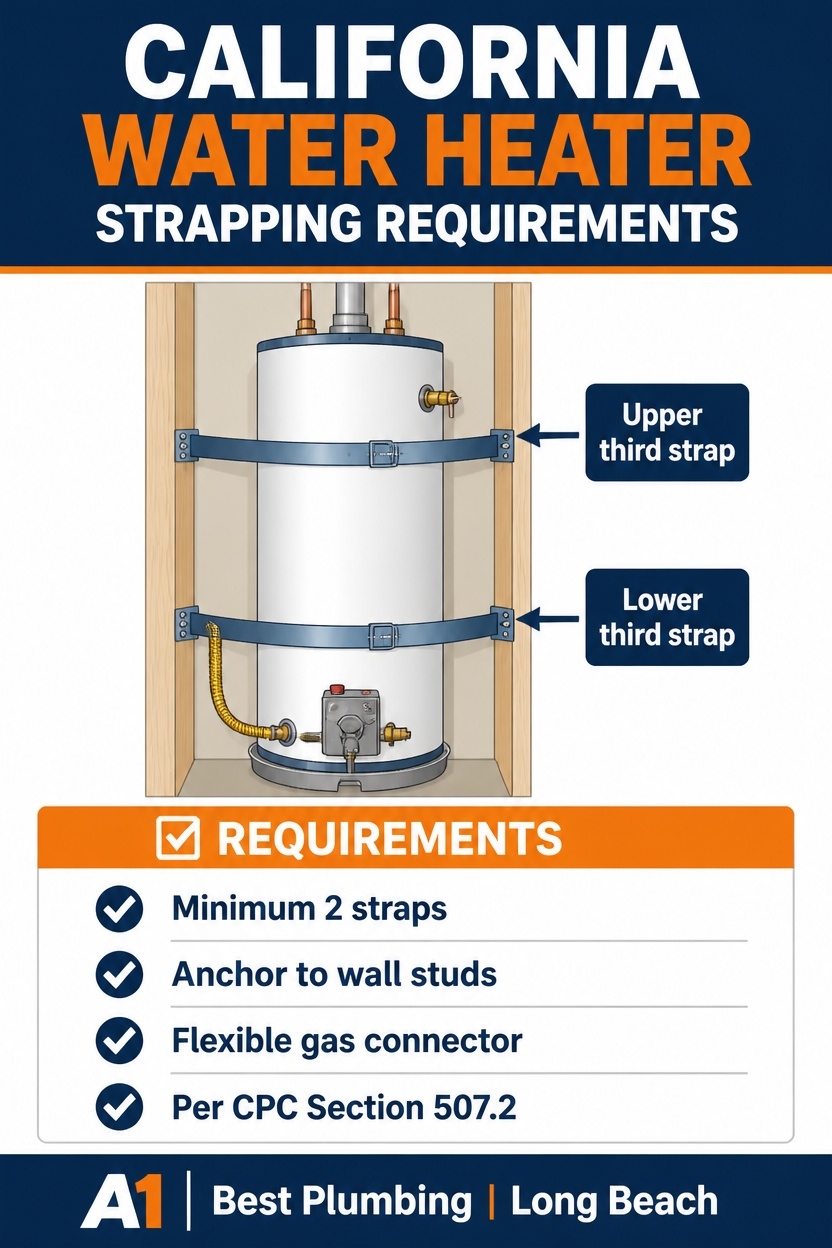
Meeting the code is straightforward. California-approved bracing guidelines require:
- Two strap sets — one in the upper third, one in the lower third — positioned to resist sliding and overturning.
- Anchoring into structure — straps bolt into wall studs, blocking, or masonry with appropriate anchors. Screws into drywall alone hold nothing in a quake.
- Flexible water and gas connectors — rigid connections defeat the purpose; flexible corrugated stainless connectors let the unit move without tearing lines.
- No reliance on plumbing as bracing — the pipes must never be the thing holding the heater up; that’s precisely the failure mode the code exists to prevent.
Strapping kits are engineered systems rated for seismic use; improvised materials (nail plates, old belts, single tension straps) don’t meet the standard. Our Long Beach Plumbing Company recommends using listed strapping kits with the manufacturer’s specified fasteners.
How to Check Your Water Heater in 5 Minutes
You can verify the basics yourself without any tools:
- Count the straps. Two visible bands, one above and one below the tank’s midpoint? You’re close to compliant — no straps at all is the biggest red flag, common on older installs.
- Follow the strap to the wall. Does it bolt into wood framing or masonry — or just drywall? Press gently on the tank: does it rock or shift?
- Check the connections. Gas and water lines should use flexible corrugated connectors, not rigid pipe.
If anything fails this checklist — or you can’t safely reach the heater — our Long Beach Plumbing Company recommends a quick professional verification. It’s one of the lowest-cost, highest-value safety checks there is.
Do Tankless Water Heaters Need Strapping?
Tankless units don’t topple the way tanks do, but they still must resist seismic movement: manufacturers and California code provisions require secure fastening to structural framing with approved brackets, plus flexible gas and water connections. If your tankless unit is mounted only to drywall, it is effectively unstrapped. Our Long Beach Plumbing Company recommends verifying the mounting hardware against the manufacturer’s manual.
What Compliance Costs
Bringing a tank into compliance is a modest expense compared with what one earthquake could cost: professional strap installation on an otherwise-healthy heater is a quick service call, and straps themselves are inexpensive. Costs rise only if the job uncovers related issues — missing flexible connectors, an improperly located TPR discharge, or a heater in a non-compliant location. Strapping is also a standard item on California home inspections, so handling it before the buyer’s inspector arrives is among the cheapest items to clear off a seller’s report.
Frequently Asked Questions
Is water heater strapping really required everywhere in California?
Yes — statewide, through Title 24 (the California Plumbing Code) and Health & Safety Code §19211, not just high-seismicity zones. Cities enforce it through permits and inspections.
Where exactly must the straps be placed?
At least two strap sets: one in the upper third and one in the lower third of the tank. A single strap, or straps at the very top and bottom edges, do not meet state guidelines.
Do I need a permit to add straps to an existing water heater?
Straps alone are typically a minor safety improvement, but any work touching gas lines, venting, or heater replacement requires a permit in Long Beach. When in doubt, ask first.
The Bottom Line
California requires every residential water heater — new, replaced, or decades old — to have at least two straps anchored to structural framing (CPC §507.2; Health & Safety Code §19211). In a city built along an active fault like Long Beach, an unstrapped heater is one of the most preventable hazards in your home.
Our Long Beach Plumbing Company recommends a same-week strapping inspection and installation so you’re compliant before the next quake — not after. A1 Best Plumbing inspects, corrects, and certifies water heater strapping throughout Long Beach and nearby communities, and we bundle it with any water heater service. Contact A1 Best Plumbing today for a fast strapping assessment and peace of mind you can point to on a wall.