
A1 Best Plumbing · Long Beach, California · Homeowner Guide
Long Beach doesn’t get its water from one place. Most homes receive a blend of local groundwater and imported Metropolitan Water District water, so mineral content shifts by neighborhood Hard water rarely announces itself. It shows up as cloudy glassware, a water heater that rumbles, and a showerhead that sprays sideways. Our Long Beach Plumbers recommend understanding what your water is doing before you spend money on a fix.
Quick Answer
Yes — Long Beach water is hard enough to cause scale damage. Reported hardness runs from about 76 ppm (4.4 gpg) in the softened groundwater blend to roughly 220 ppm (12.9 gpg) where imported MWD water dominates, with a commonly cited city average near 137 ppm (8 gpg). Anything above 120 ppm is classified as hard. The practical fix is a whole-house softener or salt-free scale control, paired with an annual water heater flush.
Table of Contents
- How Hard Is Long Beach Water, Really?
- 5 Signs Hard Water Is Already Costing You Money
- What Scale Does Inside Your Plumbing
- 5 Fixes That Actually Work
- What Our Long Beach Plumbers Recommend
- Frequently Asked Questions
Key Takeaways
- Hardness varies by zone: roughly 4 gpg in softened groundwater areas to nearly 13 gpg on imported water. Test your own tap first.
- Scale is a heat problem as much as a pipe problem. Calcium plates out fastest on hot surfaces, so heaters and dishwashers fail first.
- Spend on a water test before a softener. Hardness, iron and chlorine each call for different treatment.
- An annual heater flush costs far less than a replacement — the highest-return task in a hard-water home.
- Above roughly 7 gpg, a softener is the honest answer. Salt-free control suits moderate hardness and tight spaces.
How Hard Is Long Beach Water, Really?
Hardness measures dissolved calcium and magnesium, reported in parts per million (ppm) or grains per gallon (gpg); one gpg equals about 17.1 ppm. Standard classification puts water under 60 ppm at soft, 61–120 ppm moderately hard, 121–180 hard, and above 180 very hard.
Long Beach straddles two supply pictures, so published figures reflect a split rather than one number:
| Supply zone | Reported hardness | Classification | What it means at home |
|---|---|---|---|
| Blended groundwater | ~76 ppm (4.4 gpg) | Slightly hard | Spotting on glass; softener optional |
| MWD-served areas | ~220 ppm (12.9 gpg) | Hard | Scale on fixtures, heater, appliances |
| City-wide average | ~137 ppm (8 gpg) | Hard | Treatment worth considering |
City averages are a planning tool, not a diagnosis. Hardness moves with the season and with how much imported water is in the mix. A $15 test strip tells you what is actually arriving at your meter — and that is the number a treatment decision should be built on.
5 Signs Hard Water Is Already Costing You Money
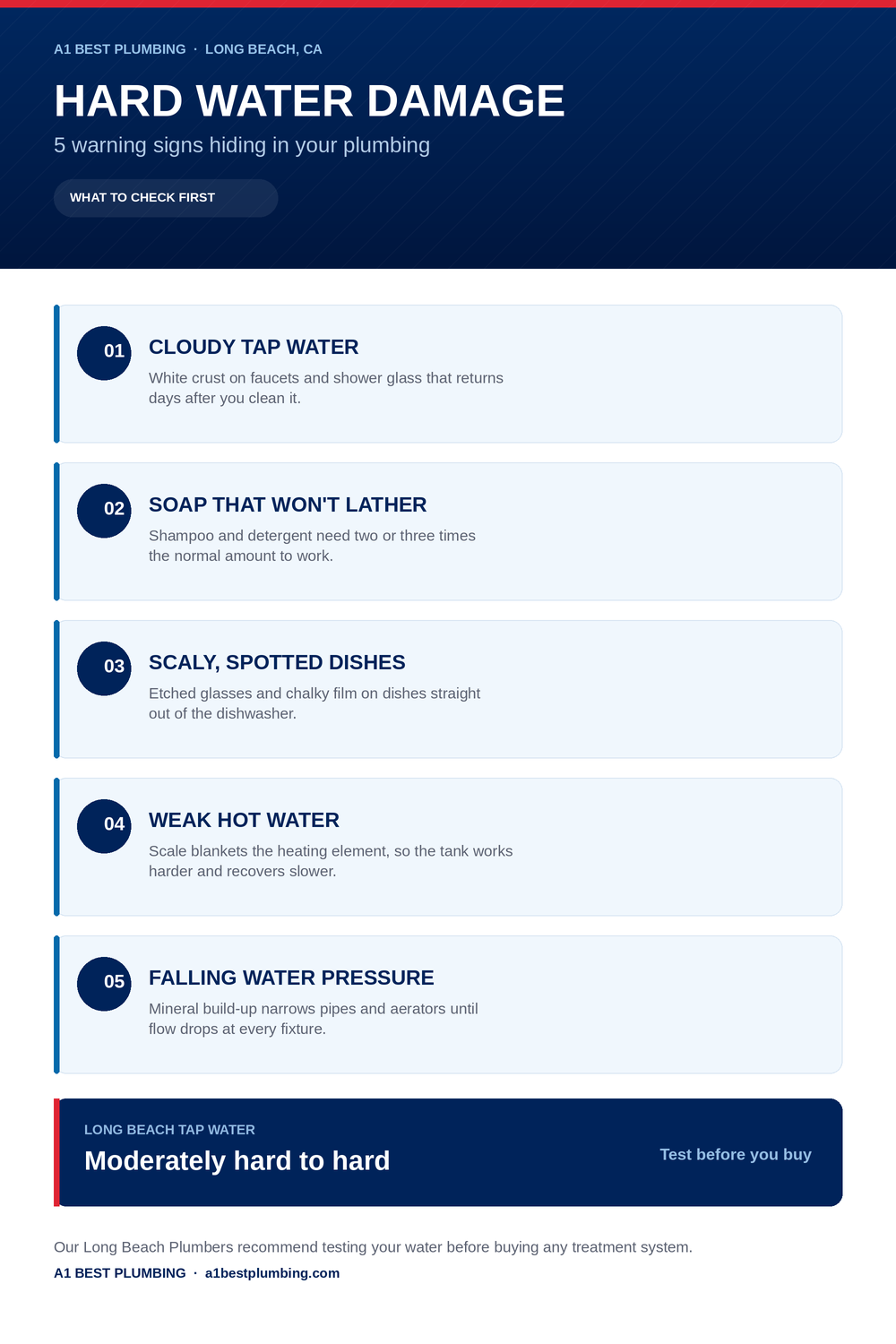
- Cloudy glassware and crusted faucets. The white film on shower doors is calcium carbonate. If it returns within days of cleaning, it is depositing continuously.
- Soap that won’t lather. Calcium binds to soap before soap can bind to dirt, so detergent gets consumed neutralising minerals instead of cleaning.
- Spotty, etched dishes. A dishwasher heats and spray-dries water — perfect conditions for mineral spotting that eventually becomes permanent etching.
- A heater that rumbles and recovers slowly. Scale insulates the tank from the burner. You hear popping as trapped water boils under the crust.
- Pressure fading at every fixture. Build-up narrows pipes and aerators from the inside. Whole-house flow loss makes scale a leading suspect.
What Scale Does Inside Your Plumbing
Scale is an insulating layer, and it forms fastest where water is heated or flow slows down.
| Component | What scale does | Typical outcome |
|---|---|---|
| Water heater | Coats the tank floor and element, forcing longer heat cycles | Higher gas bill, shorter tank life |
| Copper / galvanised pipe | Builds a rough interior lining that traps debris | Falling pressure, pinhole leaks |
| Faucets & showerheads | Blocks aerator screens and cartridge ports | Sideways spray, drip at the spout |
| Dishwasher / washer | Scales heating elements, stiffens fabric | Shorter appliance life, dull laundry |
5 Fixes That Actually Work
1. Whole-house ion-exchange softener
The proven solution. Resin swaps calcium and magnesium for sodium, giving genuinely soft water at every tap. It needs a drain, power and space, plus salt top-ups. Right call above roughly 7–8 gpg.
2. Salt-free scale control
These systems change how minerals behave so they don’t stick to pipe walls. Hardness stays in the water, but build-up drops. Good for condos and rentals where brine discharge isn’t practical.
3. Annual water heater flush and anode check
Draining the tank removes sediment before it hardens; checking the anode rod catches corrosion early. The cheapest protection available and the task most homeowners skip.
4. Fixture and aerator descaling
Unscrew aerators and showerheads, soak in white vinegar for a few hours. Scaled cartridges usually need replacement instead. This restores flow immediately where scale is the only problem.
5. Repipe when pipes are already restricted
If pressure is down house-wide and the plumbing is original galvanised steel, descaling won’t fix what is corroded shut. A PEX repipe restores full bore and ends the pinhole leaks that follow.
What Our Long Beach Plumbers Recommend
- Moderate hardness (4–7 gpg): annual heater flush and fixture descaling first. Add treatment only if spotting or heater noise continues.
- Confirmed above 8 gpg: a whole-house softener, with an untreated hard-water line to the kitchen cold tap if you prefer.
- Condo or apartment: salt-free scale control plus point-of-use filtration — brine discharge and space are usually the limits.
- Home built before 1975: assess the supply piping first. Our Long Beach Plumbers recommend fixing corroded galvanised lines before buying treatment — softening water that can’t reach the fixture solves nothing.
Frequently Asked Questions
Is Long Beach tap water safe to drink despite being hard?
Yes. Hardness is a mineral content issue, not a safety issue. Long Beach water meets state and federal standards; calcium and magnesium aren’t harmful. Many homeowners soften for appliance protection and still drink filtered hard water.
Does boiling water remove hardness?
No. Boiling kills bacteria but concentrates minerals through evaporation and speeds up scale on kettles. Only ion exchange or reverse osmosis removes hardness.
How often should a water heater be flushed in a hard-water home?
Once a year. Above roughly 10 gpg, or where the tank already rumbles, our Long Beach Plumbers recommend every six to twelve months with an anode check at the same visit.
Will a softener make my water feel slimy?
Soft water rinses differently — soap lathers easily and skin feels slippery because no mineral film is left behind. That sensation fades within a week or two.
Protect the Plumbing You Already Have
Hard water is a slow, predictable problem — which is good news, because it responds to maintenance far better than to emergency repairs. Test your water, flush the heater, and treat only at the level your numbers justify. If pressure has already dropped or your heater is rumbling, A1 Best Plumbing can measure actual hardness and recommend the narrowest fix that solves it.
Need a hard water assessment in Long Beach? We serve Long Beach, Lakewood, Signal Hill, Seal Beach and the surrounding communities. Book an inspection or call to speak with a plumber today.