
Plumbing Problems & Solutions
Earthquake-Ready Plumbing: A Long Beach Homeowner’s Checklist
The Newport-Inglewood fault runs beneath the city. Six plumbing upgrades decide whether the next sizable quake costs you a service call or a rebuild.
Quick Answer
Six items prevent most earthquake plumbing damage in Long Beach: two code-compliant straps on the water heater, a flexible stainless gas connector, a seismic gas shutoff valve installed with a city permit, a gas wrench tethered at the meter, braided stainless supply lines, and a labeled main water shutoff every adult can find. The hardware is modest. The damage it prevents — a toppled 50-gallon tank, a sheared gas line, a flooded first floor — is not.
Key Takeaways
- Water heaters are the most common plumbing casualty in a California quake, and strapping them is state law, not a preference.
- Rigid gas connections at the heater and dryer are where leaks begin; flexible stainless flexes instead of cracking.
- Long Beach does not require seismic gas valves citywide, but any valve needs a city permit and state-certified equipment.
- Rubber washing machine hoses burst under movement; braided stainless costs a fraction of the water damage.
- Find the gas meter and main water valve before you need them, and keep the wrench within arm’s reach.
Why plumbing is the weak point in a quake
Long Beach sits on the Newport-Inglewood fault, the system behind the 1933 Long Beach earthquake. Shaking rarely breaks a foundation. It breaks the connections holding a house’s water and gas systems together: the rigid pipe feeding a water heater, the sediment trap on a gas line, the hose behind a washer, the joint where copper meets slab.
The failure chain is predictable. A heater tips, the rigid gas connector cracks, and you have a gas leak plus 40 to 50 gallons of water on the move. A supply line shears and water runs for hours while nobody is home. A lateral shifts at a joint and backs up three days later.
Almost every one of those failures is preventable with hardware that costs less than a single emergency call-out.
The six-item checklist
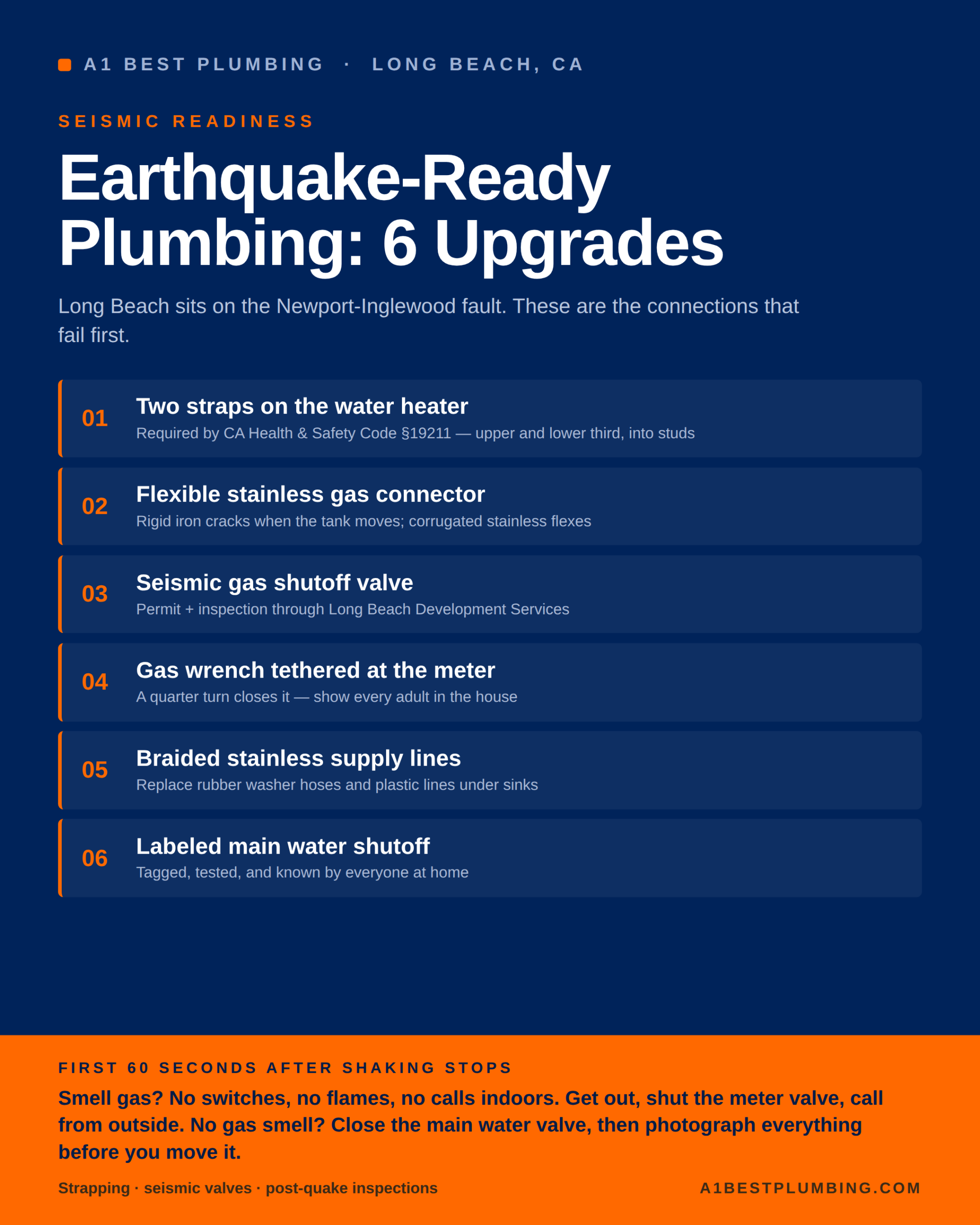
1. Two straps on the water heater
California Health and Safety Code §19211 requires residential water heaters to be braced, anchored, or strapped against earthquake movement — one strap in the upper third, one in the lower, anchored into studs or blocking, not drywall. If your tank is bare, this is the highest-return item on the list.
2. A flexible stainless gas connector
Rigid black iron from the wall to the heater and dryer cannot absorb movement; corrugated stainless can. Have a licensed plumber confirm the sediment trap and shutoff while the connection is open.
3. A seismic gas shutoff valve, installed legally
An automatic valve closes the gas supply when it senses strong ground motion. Long Beach does not require one on every home, but installation requires a permit and inspection from Long Beach Development Services, and the device must be certified to the state referenced standard.
4. A gas wrench at the meter
If you smell gas after a quake, you may need to close the meter yourself — the utility can be hours away. Tether a dedicated wrench beside the meter and show every adult the quarter turn that closes it.
5. Braided stainless supply lines
Replace rubber washer hoses and plastic lines under sinks with braided stainless. Burst hoses cause catastrophic interior flooding with or without an earthquake.
6. A labeled main water shutoff
Tag the valve, test that it turns, and teach the household. Closing it in the first minute separates a wet floor from a flooded one.
| Item | Failure it prevents | Who should do it |
|---|---|---|
| Water heater strapping | Tank tipping, gas shear, flooding | Licensed plumber |
| Flexible gas connector | Cracked gas line, fire risk | Licensed plumber |
| Seismic gas valve | Gas release after a large quake | Plumber, with permit |
| Gas wrench at meter | Prolonged gas leak | Homeowner |
| Braided supply lines | Burst hose, interior flooding | Homeowner or plumber |
| Labeled main shutoff | Uncontrolled water damage | Homeowner |
The first 60 seconds after the shaking stops
Smell gas? No light switches, no flames, no calls from indoors. Get everyone out, close the meter valve if you can reach it safely, then call the utility from outside.
No gas smell? Shut the main water valve, then check the heater and the supply lines under sinks and behind the washer. Photograph everything before you move it — adjusters want the failure in place, not after cleanup.
The 48-hour inspection
Some damage shows up late. Check the base of every toilet for rocking or a water ring, look for new cracks or damp spots along the slab, test each supply valve, and confirm the heater flue is connected and drafting. Run water in every drain and listen for gurgling — a shifted lateral announces itself that way.
If something looks off, have it scoped or pressure-tested instead of guessed at. Our Long Beach plumbers handle post-quake inspections, strapping, seismic valves, and repipes across the city.
Frequently asked questions
Is water heater strapping required in Long Beach?
Yes. California Health and Safety Code §19211 requires residential water heaters to be braced, anchored, or strapped against earthquake movement — existing homes included, not just new construction.
Do I need an automatic gas shutoff valve in Long Beach?
The city does not require seismic valves on all existing homes. If you install one, Long Beach Development Services requires a permit and inspection, and the valve must be certified to the state standard.
How much does earthquake plumbing prep cost?
Strapping, flexible connectors, and braided lines are modest line items next to the damage they prevent. A seismic valve costs more because of the permit and inspection. Ask for a quote that separates parts, permit, and labor.
Get your home quake-ready before the next one.
A1 Best Plumbing installs water heater strapping, flexible gas connectors, seismic shutoff valves, and braided supply lines across Long Beach and neighboring cities. Licensed, insured, permits handled.